

Written by Dr. Liu Xiqian
Faculty member, School of Life Sciences & Food Engineering, Anqing Normal University; doctoral graduate of Shanghai Jiao Tong University. Research focus: animal virus molecular immunology, microbiology and pathogen–host interactions. Updated August 18, 2026.
The short answer: veterinarians do use ophthalmic gentamicin for selected bacterial eye infections in dogs and cats, but a red or weeping eye is not automatically a bacterial infection. The decision changes when the cornea is scratched or ulcerated, when tear production is low, when a cat has feline herpesvirus, or when pressure inside the eye is abnormal. That is why using an old bottle because “the symptoms look the same” is one of the most disputed pieces of advice in pet forums—and one of the least reliable.
This guide explains the part usually missing from product descriptions: what a veterinarian is trying to rule out before choosing an antibiotic, what owners can safely observe at home, and where a gentamicin product fits after the eye problem has been properly classified.
Why “my pet has eye discharge” is not a diagnosis
The surface of the eye can respond to very different problems with the same small set of signs: watering, mucus, redness, blinking and squinting. Dust or wind can cause clear tears. Dry eye may cause sticky gray mucus. A blocked tear duct can keep the face wet. Conjunctivitis can be allergic, viral or bacterial. A hair, seed or scratch can create intense pain before obvious damage is visible. Glaucoma can begin with redness and a cloudy appearance but threatens vision.
Yellow or green material raises concern for infection, yet even this does not tell an owner whether bacteria are the primary problem or are taking advantage of an ulcer, dry eye or abnormal eyelid. Treating the bacteria while missing the underlying cause may produce partial improvement followed by recurrence.
What gentamicin actually does
Gentamicin is an aminoglycoside antibiotic. In an ophthalmic formulation it acts against susceptible bacteria on the eye's surface. It does not kill viruses, correct tear drainage, remove an embedded foreign body, lower dangerous eye pressure or bleach tear-stained hair. It also is not the right antibiotic for every bacterium.
| Situation | Could gentamicin be relevant? | What still needs answering? |
|---|---|---|
| Veterinarian suspects a susceptible bacterial conjunctivitis | Possibly | Is the cornea intact and is this the correct formulation? |
| Cat with recurrent watery eye and sneezing | Not automatically | Could feline herpesvirus or another respiratory cause be involved? |
| Dog with thick mucus and a dull-looking cornea | Secondary infection may coexist | Is tear production abnormally low? |
| Eye held shut after a walk | Do not trial medication first | Is there a scratch, plant material or ulcer? |
| Brown staining on white facial hair | Usually not the primary answer | Why are tears overflowing and keeping the hair wet? |
The corneal-ulcer issue behind the forum debate
Owners often ask why a clinic wants to stain the eye before prescribing drops. Fluorescein dye adheres to areas where the outer corneal barrier is missing, helping reveal an ulcer that may be difficult to see. The result matters because an ulcer changes medication choices, urgency and follow-up. Veterinary references also note that high concentrations or very frequent gentamicin exposure can be toxic to corneal epithelial cells and may slow epithelial healing. This does not mean gentamicin is universally “bad for the cornea”; it means the diagnosis, product and schedule cannot be separated.
A painful eye should therefore not be treated as a casual online experiment. Squinting, avoiding light, rubbing the face, holding one eye closed or developing a blue/cloudy surface are more important urgency signals than discharge color alone.
Cats add another question: could this be feline herpesvirus?
Recurrent conjunctivitis and corneal disease in cats can be associated with feline herpesvirus-1. Stress-related flare-ups, one-eye symptoms that later involve the other eye, sneezing or a history of shelter illness can all appear in owner discussions. An antibiotic does not treat the virus itself, although a veterinarian may address a secondary bacterial component when present. Repeatedly switching antibiotics without revisiting the diagnosis can delay a more useful plan.
Why an old or borrowed bottle is a poor shortcut
- The cause may be different. Two red eyes can require opposite treatment decisions.
- The tip may be contaminated. Contact with lashes, discharge, fingers or skin can introduce organisms.
- Storage may be unknown. Heat, light, time after opening and damaged seals can affect a product.
- The formulation may be wrong. Ear and skin products are not substitutes for an ophthalmic product.
- Partial treatment can confuse the picture. Symptoms may temporarily change without the underlying condition resolving.
What a useful veterinary eye examination may include
Depending on the case, the veterinarian may inspect beneath the eyelids, stain the cornea, measure tear production, check eye pressure and examine the internal structures. A culture is not required for every uncomplicated case, but it becomes more relevant when infection is severe, recurrent, unusual or unresponsive. These steps are not obstacles placed between an owner and a bottle; they are how a clinician distinguishes an antibiotic-responsive problem from a vision-threatening look-alike.
How to give prescribed eye drops without turning it into a wrestling match

- Prepare the medication and a reward before bringing the pet into position.
- Wash and dry your hands. Gently remove loose material from surrounding fur with clean gauze and sterile saline if your veterinarian has approved it.
- Approach from above or behind so the bottle is less threatening. Support the head without pressing the throat.
- Keep the nozzle above the eye. Never touch the cornea, eyelids or fur with the tip.
- Apply exactly what the label or veterinarian directs. More liquid does not make treatment stronger.
- Recap immediately and record the dose. If several eye medicines are prescribed, follow the clinic's instructions about order and spacing.
Antibiotic resistance: why “stronger drops” is the wrong goal
Gentamicin is sometimes described online as a “strong” antibiotic, but strength is not a useful way to select an antimicrobial. The important question is whether the suspected organism is susceptible and whether enough medication can reach the relevant tissue without damaging the surface. Repeated short, incomplete or unnecessary courses can select for resistant organisms and make later infections harder to interpret.
When an eye infection is recurrent, severe, associated with corneal melting or unresponsive to initial treatment, a veterinarian may collect material for cytology, culture and susceptibility testing. Those tests can reveal whether bacteria are actually present, their shape and inflammatory context, and which antibiotics are more likely to work. They also prevent a false escalation in which owners keep buying broader products for a problem that is viral, inflammatory or structural.
Combination eye drops deserve extra caution
Some ophthalmic products combine antibiotics with anti-inflammatory drugs. Owners may see fast reduction in redness and assume the infection is cured. However, corticosteroid-containing eye medicines can be inappropriate when a corneal ulcer or certain infections are present. Never choose a combination product by matching package words such as “redness” or “inflammation.” The complete ingredient panel and corneal examination matter.
Drops versus ointment is not simply preference
Drops are quick to apply and may blur vision less, while ointments remain on the surface longer and can be easier or harder depending on the animal. The diagnosis, required contact time, other medications and the pet's tolerance influence the choice. Do not move medication from one container to another or use a non-ophthalmic cream in the eye.
When waiting is the wrong decision
Seek same-day or emergency care for an eye that is held closed, markedly painful, cloudy or blue; a bulging eye; unequal pupils; a visible wound or object; bleeding; chemical exposure; sudden loss of vision; severe swelling; or rapid deterioration. Young animals, flat-faced breeds and pets with only one functional eye deserve an especially low threshold for urgent assessment.
Where Cassiel Pet fits—after the diagnosis question
Cassiel Pet maintains an Eye & Ear Care collection for owners comparing daily hygiene and targeted eye-care formats. If an ophthalmic gentamicin product is appropriate, the product page is where formulation, current directions, price and purchase options belong.
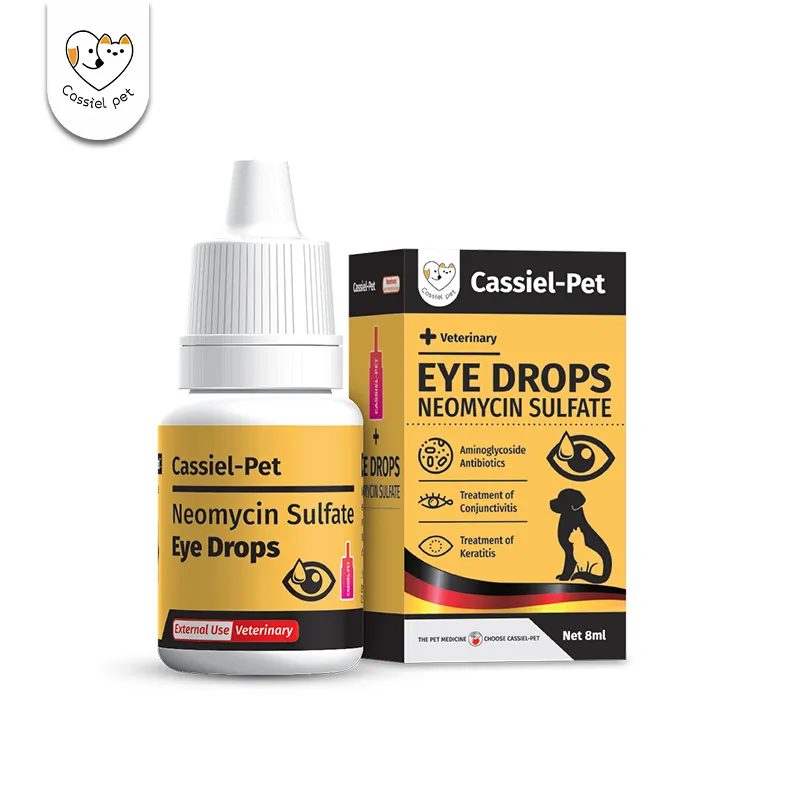
Cassiel Pet Gentamicin Eye Drops
Consider only when: the eye condition has been assessed, an antibacterial ophthalmic product is appropriate, and the current label matches the dog or cat.
Do not use this card to self-diagnose: pain, cloudiness, trauma and suspected ulceration still require examination.
Frequently asked questions
Can I use human gentamicin eye drops on my dog or cat?
Do not substitute a human prescription or any other formulation without a veterinarian confirming the exact product and diagnosis. “Gentamicin” on the label is not the only safety variable.
Do yellow or green eye discharges always require gentamicin?
No. They justify a prompt examination, but the underlying cause and bacterial susceptibility determine treatment.
Can gentamicin clear tear stains?
It does not remove pigment already deposited in hair and should not be used solely as a cosmetic tear-stain product.
My pet looks better after one day. Can I stop?
Follow the prescribed plan and review instructions. Early visible improvement does not prove that the original problem is resolved.
What if the dropper touched the eye?
Contact the prescriber or manufacturer for advice about contamination and possible injury; do not wipe the tip with a household disinfectant.
Sources
Educational content, not veterinary diagnosis. Reviewed August 18, 2026.
0 comments